
=== URGENT HEALTH REPORT === One of America’s most popular “healthy drinks” could be contributing to stubborn belly fat. In reality, it’s actually one of the worst things you can do for your waistline. Fortunately, there’s a simple way to fight back… by addressing what’s really behind the weight gain. Those who’ve implemented this 1 “gut trick” have reported radical improvements in digestion, energy, and a flatter stomach.†* Watch the short video now before it's taken down >>>
============ Today's Article ============ Dear , Over the last decade a new class of sweeteners – known as sugar alcohols or polyols – has made its way into thousands of consumer products worldwide. You’ve probably seen ingredients like erythritol, xylitol, mannitol, maltitol, sorbitol and others listed on the nutrition labels for everything from gum and mouthwash… to soda, cookies, ice cream and more.
The use of polyols has exploded because of their ability to offer sweetness,
without the blood-sugar spike and other health consequences of fructose and glucose.
But you might have also heard (or experienced) that some sugar alcohols can cause digestive distress, due to their classification as FODMAPs. While this statement is absolutely true – and you’ll discover why in a moment – there is one sugar alcohol for which it does not apply…
Erythritol.
Why?
The chemical composition of erythritol is very different from other sugar alcohols.
Today, I’ll show you how these chemical and structural differences make it a far superior choice when it comes to your digestive (and overall) health. And we’ll discuss the specific properties that set erythritol apart from other sugar alcohols.
But first, it is important to
understand…
What are FODMAPs and Why do they Cause Digestive Distress (For Some People)?
The term FODMAPs is an acronym for Fermentable Oligosaccharides, Disaccharides, Monosaccharides and Polyols. These compounds are found in a wide variety of foods.
And there is considerable confusion about them, because many of the worst offenders are (otherwise) some of the healthiest foods!
For example, apples, asparagus, blackberries, Brussels sprouts, garlic, onions and sweet potatoes are all FODMAPs. While these colorful fruits and vegetables appear to be the foundation of a healthy diet, they can cause severe digestive illness for some
for some people.
The reason why is related to the “F” in FODMAPs – fermentable.
Fermentable carbohydrates are not broken down by digestive enzymes. Instead, we rely on microorganisms in our gut to break these compounds into smaller
particles by way of fermentation. For those people with a healthy gut and microbiome, fermentable carbohydrates can be a good thing.
These compounds feed beneficial bacteria. This helps to increase their numbers and produces health-promoting compounds. For example, when the “good” gut bacteria Roseburia feeds on fermentable carbs, short chain fatty acids
(SCFAs) are formed. These compounds protect against leaky gut, cancer and inflammation… to name just a few benefits!
But it is very important to understand that fermentable carbohydrates do not just feed your “good” gut bugs… pathogenic organisms (like gram-negative bacteria) also thrive on these substances!
If you have an unhealthy, imbalanced microbiome (dysbiosis), foods which might be perfectly healthy for some people could cause you severe digestive distress and long-term illness.
When “bad” gut bacteria enjoy a fermentable substrate, they often produce gas and
bloating. These symptoms are certainly uncomfortable and embarrassing. But that’s not the worst part!
Strains of harmful bacteria also produce toxic byproducts like inflammatory endotoxins and cytokines and lipopolysaccharides (LPS), which are linked to liver disease, leaky gut, metabolic syndrome, Chrohn’s disease and
autoimmune conditions (to name a few).
So it’s not just about reducing symptoms – but reducing your risk for disease as well.
Therefore, avoiding foods and substances that encourage the growth of “bad bugs” is vital.
So, let’s get back to polyols (the “P” in FODMAPs) and discuss what sets erythritol apart…
Erythritol: The Simplest of All Sugar Alcohols
When it comes to
chemistry, the structure and the function of a molecule are inextricably linked.
The number of elements and how these elements are arranged can make a huge impact on how a substance behaves. For example, water and hydrogen peroxide are both very simple molecules consisting of hydrogen and oxygen. But there is a BIG difference between H2O and H2O2.
In a review article on the link between gastrointestinal disturbances and sugar alcohols, researchers in the International Journal of Dentistry state that:
“Sugar alcohols behave in the gut in different ways. Their effects are not identical. Sugar alcohol
molecules react in the gut as physical and chemical entities based on their molecular mass, number of hydroxyl groups, the spatial orientation of those groups, and the overall symmetry of the molecule.”
When it comes to sugar alcohols, mass (molecular weight) and the number of hydroxyl groups (hydrogen and atoms bonded together)
are the two most important molecular factors to understand the fermentation potential of different sugar alcohols.
The higher the mass and the more hydroxyl groups (-OH) a sugar alcohol has, the greater the risk for digestive discomfort.
As you can see in the table below, erythritol has the lowest molecular weight and the fewest hydroxyl groups of all the sugar alcohols… 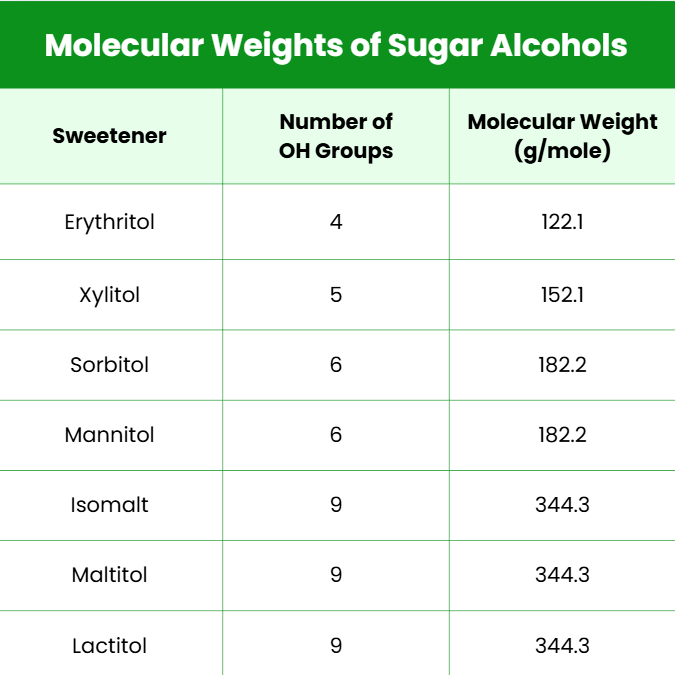
You can also see that mannitol and maltitol – two sugar alcohols well-known known for their ability to cause extreme digestive distress – are MUCH higher by both measures. The same is true for sorbitol, which is often used as a laxative. This is why many people who are sensitive to sugar alcohols often have trouble with sorbitol-rich fruits like apples, cherries, plums, peaches and apricots. This alone doesn’t prove erythritol is not fermentable, but it does illustrate… Why Erythritol is the Best Sugar Alcohol to Consume We’ve all heard the adage that, “What goes in must come out.” When it comes to most food, however, what comes out is very different than what
went in…
As we metabolize proteins, fats and carbohydrates, they are broken down and transformed by enzymes, acids and bacteria to produce a wide variety of health-promoting (and sometimes health-harming) byproducts.
But in the case of erythritol, what comes out is exactly
what went in… Because of its simple structure, 90% of the erythritol you consume is absorbed in the gut and then excreted in your urine completely unchanged. Take a look at the absorption, fermentation and excretion of the various sugar alcohols from Nutrition Research Reviews:
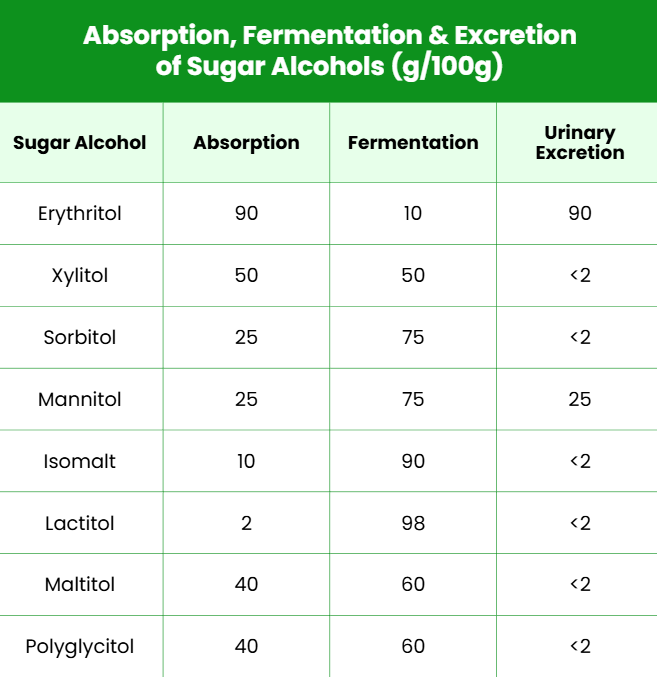
Given the above, you
might wonder what happens to the 10% of erythritol that makes it to the colon?
Is it fermented like other sugar alcohols and fermentable carbohydrates?
Research published in the British Journal of Nutrition provides an answer...
In the study, researchers evaluated the fermentation potential of erythritol compared to other sugars and sugar alcohols. The researchers discovered that the small amount of erythritol that did make it to the colon was “completely resistant to bacterial attack”.
The researchers found that no gasses or short chain fatty acids (SCFAs) were produced as the result of fermentation… and the erythritol was recovered unchanged after traversing the colon.
Because erythritol does NOT ferment in the gut it is technically not a FODMAP.
Erythritol Does NOT Feed Any Gut Bacteria (Good – or Bad!)
These unique attributes make erythritol the perfect gut-friendly sweetener. Not to mention that it is nearly as sweet as sugar with a very similar taste profile – while boasting zero calories and zero glycemic impact.
On a related side note, this and many other reasons is why I chose erythritol as the primary sweetener in my book, Keto Desserts...
It should also come as no surprise that when scientists evaluated the maximum tolerable dose of various sugar alcohols (without causing digestive discomfort or laxative effects) that erythritol has the highest digestive
tolerance.
Based on this research, a 100 pound woman could consume 36 grams of erythritol without experiencing gastrointestinal disturbances. For sake of comparison, one serving the average dessert in Keto Desserts contains just 8 grams of erythritol.
That would mean – theoretically – that you could enjoy nearly five cupcakes
without experiencing an issue. Although, I have been formulating with and consuming this ingredient for more than a decade and have never experienced digestive symptoms from it.
Now, after all of this science, you might be wondering…
How Does Erythritol
Fit in an Ancestral Diet?
The truth is, if you’re eating an ancestral diet, you’re already consuming erythritol.
It’s a naturally occurring substance (not artificial as it is sometimes purported to be!) that is found in a wide variety of foods, including pears,
watermelon, mushrooms, soy sauce and wine. In fact, it is even produced within the body, which means your physiology is intimately familiar with this substance.
If you follow an ancestral, Low FODMAP diet, you can rest easy knowing that erythritol is a safe and clean
addition to your dietary protocol.
Now that’s what I call having your cake and eating it too!
To Your Health,
Kelley Herring
Healing Gourmet
*All individuals are unique. Results can and will vary. ✝ These statements have not been evaluated by the Food and Drug Administration. This product is not intended to diagnose, treat,
cure or prevent any disease. REFERENCES Canani RB, Di Costanzo M, Leone L, Pedata M, Meli Fletcher R, Calignano A. Potential beneficial effects of butyrate in intestinal and extraintestinal diseases. World Journal of Gastroenterology.
2011;17(12):1519–1528. PMID: 21472114
Bultman SJ. The microbiome and its potential as a cancer preventive intervention.
Seminars in Oncology. 2015;43(1):97–106. PMID: 26970128
Zhou S-Y, Gillilland M III, Wu X, Leelasinjaroen P, Zhang G, Zhou H, Ye B, Lu Y, Owyang C.
FODMAP diet modulates visceral nociception by lipopolysaccharide-mediated intestinal inflammation and barrier dysfunction. The Journal of Clinical Investigation. 2018;128(1):267–280. PMID: 29202473
Bischoff SC, Barbara G, Buurman W, Ockhuizen T, Schulzke J-D, Serino M, Tilg H, Watson A, Wells JM.
Intestinal permeability— a
new target for disease prevention and therapy. BMC Gastroenterology. 2014;14:189. PMID: 25407511
Kauko K. Mäkinen, “Gastrointestinal Disturbances Associated with the Consumption of Sugar Alcohols with Special Consideration of Xylitol: Scientific Review and Instructions for Dentists and Other Health-Care Professionals,” International Journal of Dentistry, vol.
2016, Article ID 5967907, 16 pages, 2016. F. Rincón-León, in Encyclopedia of Food Sciences and Nutrition (Second Edition), 2003 Livesey, G. (2003). Health potential of polyols as sugar replacers, with emphasis on low glycaemic properties. Nutrition Research Reviews,
16(2), 163-191. doi:10.1079/NRR200371 Arrigoni, Eva & Brouns, Fred & Amadò, Renato. (2005). Human gut microbiota does not ferment erythritol. The British journal of nutrition. 94. 643-6. 10.1079/BJN20051546. Storey, D, Lee, A, Bornet, F, Brouns, F. Gastrointestinal
tolerance of erythritol and xylitol ingested in a liquid. European Journal of Clinical Nutrition. 2007;61(3):349. At Healing Gourmet, we are strongly committed to protecting your privacy and providing a safe & high-quality online experience for all of our visitors. We
understand that you care about how the information you provide to us is used and shared. We have developed a Privacy Policy to inform you of our policies regarding the collection, use, and disclosure of information we receive from users of our website. Healing Gourmet operates the Website. Our Privacy Policy, along with our Term & Conditions, governs your use of this site. By using website link,
or by accepting the Terms of Use (via opt-in, checkbox, pop-up, or clicking an email link confirming the same), you agree to be bound by our Terms & Conditions and our Privacy Policy. If you have provided personal, billing, or other voluntarily provided information, you may access, review, and make changes to it via instructions found on the Website or by emailing us at our support email
address. To manage your receipt of marketing and non-transactional communications, you may unsubscribe by clicking the “unsubscribe” link located on the bottom of any marketing email. Emails related to the purchase or delivery of orders are provided automatically – Customers are not able to opt out of transactional emails. We will try to accommodate any requests related to the management of Personal Information in a timely manner. However, it is not always possible to completely remove or modify
information in our databases (for example, if we have a legal obligation to keep it for certain timeframes, for example). If you have any questions, simply reply to this email or visit our website to view our official policies. You are receiving this message because you either purchased one of our top-selling health products or joined us from our website. Please know we are happy to have you as a
devoted reader, but if you decide to, you can change your email preferences at any time. Remember, we have plenty more recipes, cooking tips, and articles on our website. The information provided by Healing Gourmet is for informational purposes only and is not intended as medical advice. It is not a substitute for professional medical consultation, diagnosis, or treatment. Always seek the
advice of your physician or other qualified health providers with any questions you may have regarding a medical condition. Never disregard professional medical advice or delay in seeking it because of something you have read on our website or through our communications. Healing Gourmet does not endorse or recommend any specific tests, physicians, products, procedures, opinions, or other information that may be mentioned on the website. Reliance on any information provided by Healing Gourmet is
solely at your own risk. All content, concepts, phrases, subject lines and copy in this newsletter are the exclusive property of Health-e Enterprises, LLC. Unauthorized use, reproduction, distribution, or modification for any purposes, including marketing, derivative works, or otherwise, is strictly prohibited. Legal action will be pursued against any infringement. © Health-e Enterprises, LLC. All rights reserved. |
|
|
|